


Are you preparing to establish a glass deep-processing plant but feeling overwhelmed by complex equipment lists and technical workflows? Blind investment can easily lead to idle production lines or skyrocketing defect rates. Based on the latest industry standards, this guide breaks down the configuration logic of "basic tempering equipment" and "high value-added deep-processing lines" into five core modules. This will help you secure production stability and maximize profit margins from the very beginning.
What Core Equipment is Required to Set Up a Basic Tempering Line?
What Does the Essential Tempering Equipment List Include?
Regardless of the specific glass type you intend to produce, the following five pieces of equipment form the prerequisite for physical tempering and compliance with national 3C mandatory certification:
CNC Glass Cutting Machine: Cuts large raw glass sheets into required dimensions with a precision tolerance of ±0.2mm.
Glass Washing and Drying Machine: Utilizes deionized water to thoroughly remove surface impurities, preventing defects like white spots or haze during high-temperature processing.
Linear / Double Edging Machine: Performs chamfering, edge smoothing, and polishing to eliminate stress concentration points and prevent spontaneous breakage.
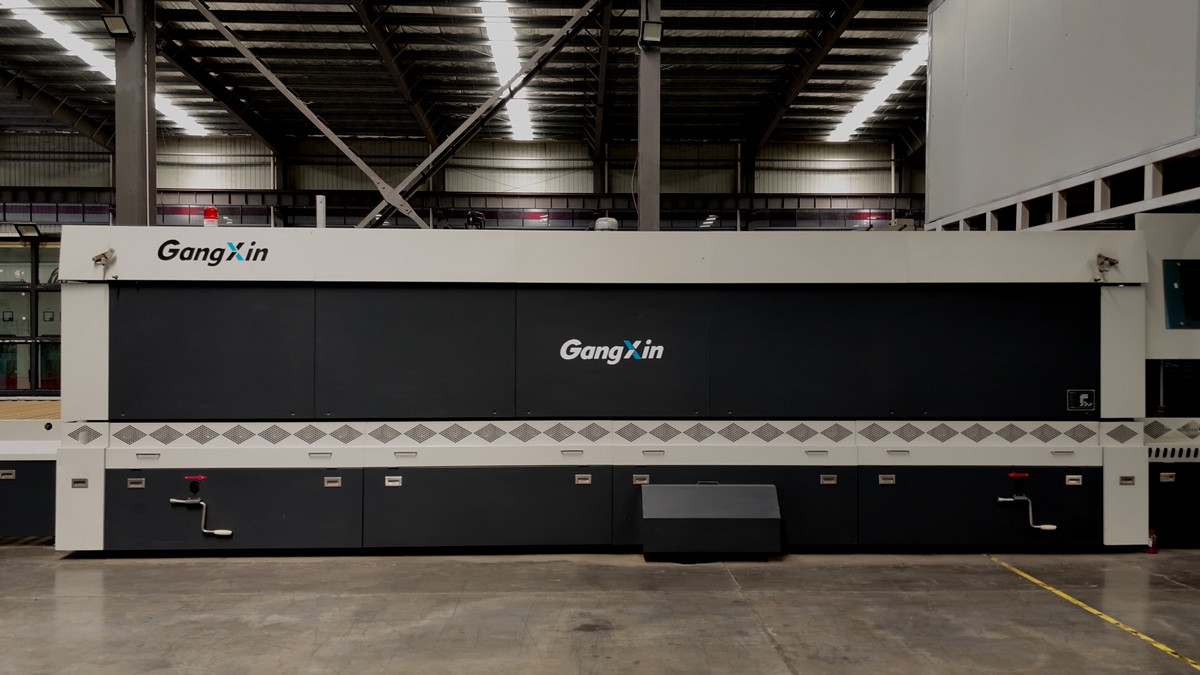
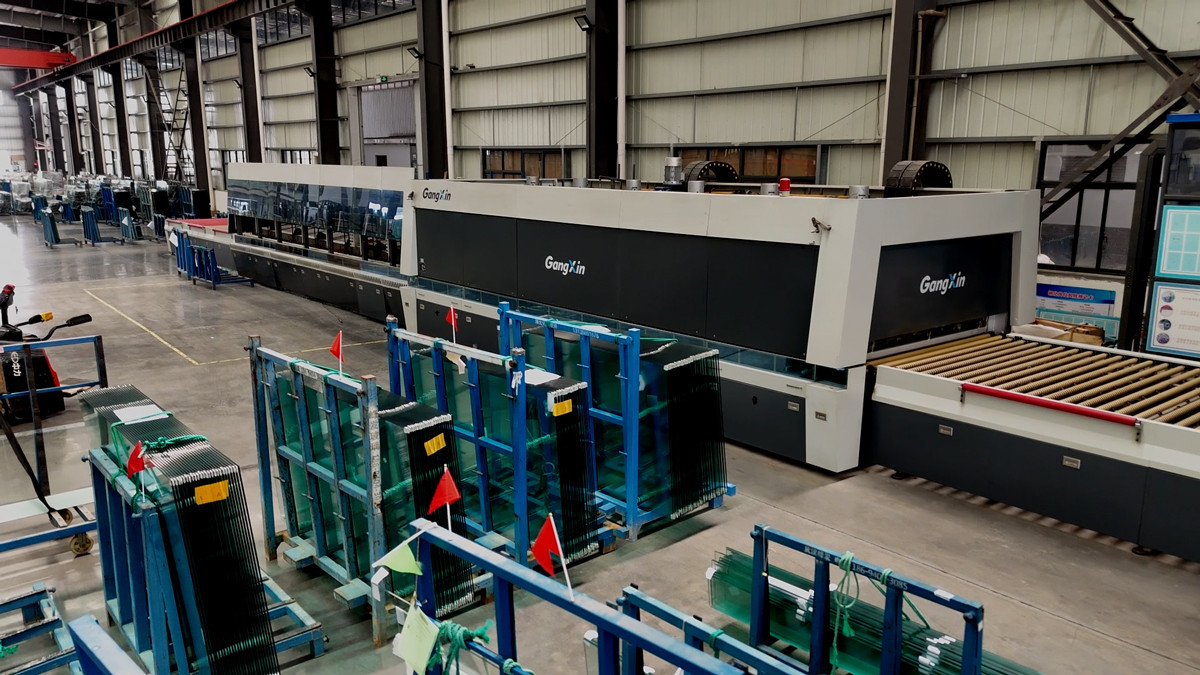
Glass Tempering Furnace: The core equipment, comprising a heating section (650-700°C) and a high-pressure air quenching section.
Air Compressor and Transformer: Provide a stable, high-pressure air supply and meet the 380V industrial power requirements for the entire plant.
What is the Standard Production Workflow for Basic Tempered Glass?
Cutting and Pre-processing: Raw glass is cut to size (tolerance ≤ ±0.5mm), followed by edge grinding, chamfering, and drilling.
Washing and Drying: High-pressure pure water rinses the glass, which is then thoroughly dried to ensure a completely clean and dry surface.
Thermal Tempering: Glass is uniformly heated to its softening point at 650-700°C, then rapidly cooled on both sides by high-pressure air jets (wind speed up to 30 m/s).
Quality Inspection and Packaging: Flatness and stress values are tested. Qualified products are labeled with the 3C mark and packaged vertically with interleaving paper.
What Additional Equipment is Needed for Insulating Glass Production?
Incremental Equipment and Workflow for Insulating Glass
Insulating glass (e.g., 6mm+12A+6mm structure) is the absolute mainstream in architectural doors and windows, offering superior thermal insulation, soundproofing, and anti-condensation properties.
Required Equipment: An Insulating Glass Production Line equipped with a plate press. Key components include a butyl extruder, aluminum spacer bending machine, molecular sieve auto-filling machine, and a dual-component sealant dispensing machine. (High-end setups also require an argon gas filling system).
Production Workflow: Wash and dry tempered glass → Bend aluminum spacers and fill with molecular sieve → Extrude butyl sealant (inner seal) → Assemble two glass panes with the spacer and apply plate pressing → Apply dual-component structural sealant (outer seal) → Curing.
What Additional Equipment is Needed for Laminated Glass Production?
Incremental Equipment and Workflow for Laminated Glass
Laminated glass (bonded with PVB/SGP interlayers) remains intact upon breakage, making it the standard for high-rise curtain walls, sunroom roofs, and automotive windshields.
Required Equipment: A pre-nipping machine (pre-pressing roller) and an Autoclave (the core equipment that uses high temperature and pressure to permanently bond the interlayer to the glass).
Production Workflow: Wash and dry glass → Lay PVB/SGP interlayer in a cleanroom → Pre-nip to exhaust air and prevent bubbles → Load into the autoclave (maintain at approx. 130°C and 1.2 MPa) → Cool down and trim edges.
How to Configure Production Lines for Fire-Resistant and Decorative Glass?
Incremental Equipment and Workflow for Fire-Resistant Glass
Fire-resistant tempered glass is a mandatory material for fire compartmentalization in public buildings like large malls and hospitals.
Required Equipment: A fire-resistant glass composite production line (equipped with liquid filling or interlayer pressing equipment).
Production Workflow: Composite tempered glass with fire-resistant liquid/interlayer → Inject fire-resistant slurry or high-temperature lamination → Curing reaction at specific temperatures → Edge sealing and weathering treatment.
Incremental Equipment and Workflow for Decorative Glass
This category includes silk-screen printed glass, ceramic frit glass, and UV-printed glass, widely used for interior partitions, furniture panels, and home appliance glass.
Required Equipment: Glass screen printing machines, UV printers, and waterjet cutting machines (for complex custom shapes).
Production Workflow: Wash and dry glass → Screen print ink/silver paste or UV print patterns → Dry and cure → Load into the tempering furnace for high-temperature sintering (fusing the ink permanently into the glass) → Waterjet cutting for custom shapes.
FAQ: Quick Reference for New Plant Investors
Q1: What equipment should new investors prioritize?
It is highly recommended to start with the "Basic Tempering Line + Insulating Glass Line" to generate steady cash flow. Once sales channels are stable, gradually expand into autoclaves (laminated) or fire-resistant lines to avoid cash flow disruptions caused by heavy upfront capital expenditure.
Q2: What are the strict requirements for selecting a tempering furnace?
Prioritize mature brands with reliable after-sales support to ensure precise temperature control and stable air pressure. Never buy unbranded or assembled equipment just to save costs; high defect rates will completely wipe out your profits.
Q3: What are the prerequisites for factory construction?
Tempering furnaces are highly energy-intensive. You must confirm that the site supports 380V industrial power with a capacity of at least 800 KVA. Additionally, you must reserve space for environmental dust extraction and wastewater settling tanks to comply with strict environmental regulations.
Conclusion: 3 Golden Rules for Plant Configuration
Rule 1: The basic tempering line is the absolute prerequisite for 3C certification and all subsequent deep-processing.
Rule 2: Insulating and laminated glass equipment forms the core profit driver for the architectural doors and windows market.
Rule 3: Fire-resistant and decorative equipment should be added strictly based on local market demand.
Action Step: Immediately assess the number of local door/window manufacturers and public construction projects in your area to calculate the daily tempering demand. Avoid blindly expanding all product lines at once.