


Have you noticed that the yield rate of tempered glass fluctuates unpredictably while energy consumption remains stubbornly high? The root cause often lies not in your process parameters, but in the performance weaknesses of the four core components: the blowers, heating elements, ceramic rollers, and the control system. Drawing on verified performance data from first-tier manufacturers such as Luoyang Gangxin Glass Technology Co., Ltd., this article breaks down the truth about component selection from three critical dimensions, helping you lock in equipment stability and product quality right from the source.
How Does the “Dual-Fan System” Affect Glass Stress Uniformity?
Fans play distinct roles in different sections of a tempering furnace, and the critical performance indicators vary by fan type.
In the quenching section, the large quench blower acts as the heart of the system, directly determining the balance between the glass surface compressive stress and the internal tensile stress. Its key metrics are air pressure stability and airflow uniformity. A premium quench blower must deliver stepless adjustable air pressure in the 8–12 kPa range, with an airflow deviation of ≤3% between the upper and lower quench air bars. Failure to meet these requirements easily leads to stress marks, warpage, or even glass breakage.
Inside the heating section, the installed convection fans primarily influence heat transfer uniformity as the glass heats up. Beyond matching airflow and pressure to heating requirements, the precision of their variable-frequency drive (VFD) control is particularly critical. Accurate VFD regulation enables superior control of the heating rate and temperature uniformity, ensuring consistent glass quality during the heating phase.
Real-World Case: Blower Optimization at Gangxin
Luoyang Gangxin Glass Technology has implemented targeted optimizations for the different fans in its high-end tempering furnaces. For the quench blower, the company adopted a specialized impeller and bearing structure for more balanced force distribution, combined with an advanced vibration-damping design. Under high-frequency, high-intensity operation, the vibration amplitude has been reduced by 40% compared to conventional designs, effectively safeguarding air pressure stability and airflow uniformity. Verified performance data shows that the optimized quench blower reduces glass stress marks by 70% (compared to furnaces with non-optimized blowers), with marked improvements in reducing warpage and breakage.
For the heating section convection fans, Gangxin uses a top-mounted, independently air-cooled, internal recirculation high-temperature-resistant design. This allows the fan impeller to maintain excellent operational integrity in extreme heat. This design has increased the convection airflow for heating Low-E glass by more than 10 times, significantly enhancing heating uniformity and further elevating overall product quality.
How Does Heating Element Material Determine Furnace Temperature Uniformity?
Heat Resistance and Service Life of Different Heating Elements
Heating elements are the thermal heart of a tempering furnace, and the material directly dictates its maximum temperature limit and operational lifespan. Conventional FeCrAl (iron-chromium-aluminum) wire typically withstands temperatures around 1200°C and lasts 1–2 years. High-end NiCr (nickel-chromium) alloy wire can endure up to 1400°C, delivers a service life of 3–5 years, and features a low temperature coefficient of resistance, enabling more precise temperature control. Inferior recycled wire is prone to fracture and rapid oxidation, making it a primary cause of furnace temperature fluctuations.
Gangxin’s Zoned Temperature Control for Heating Systems
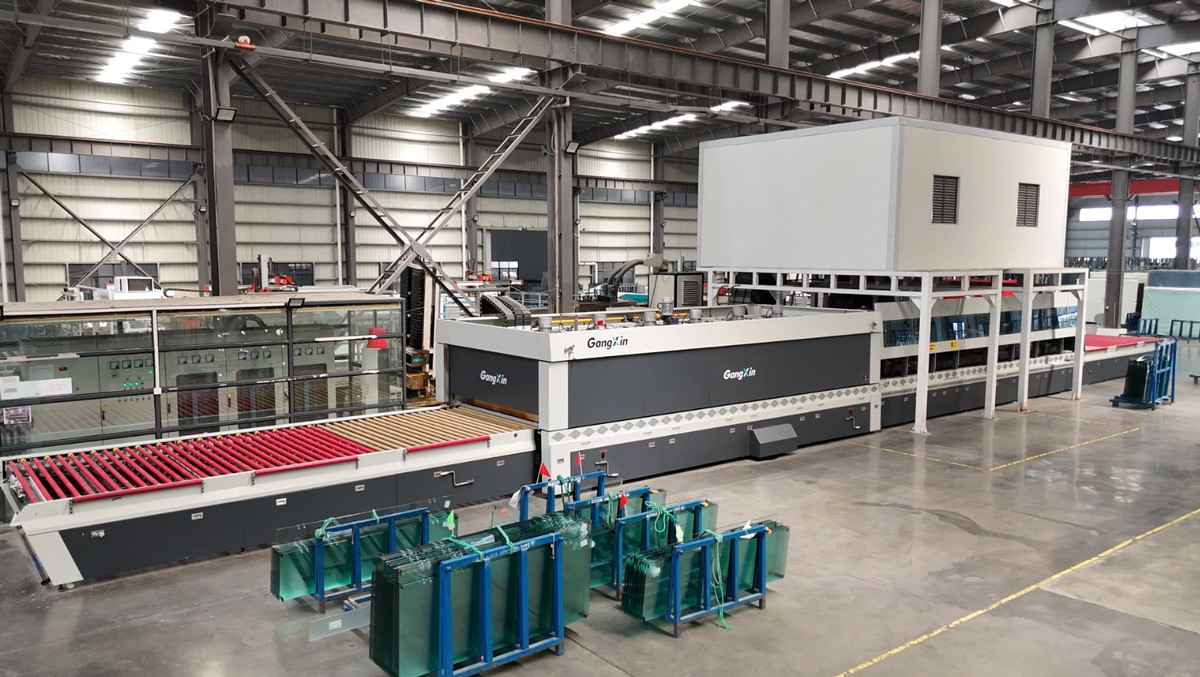
Luoyang Gangxin tempering furnaces employ a high-density, multi-zone heating layout. The entire upper section utilizes NiCr alloy elements, installed at an optimized tilt angle and in a staggered arrangement to eliminate heating blind spots. Coupled with a two-stage air-outlet pressure equalization structure, the temperature differential within the furnace is controlled within ±1°C. This reduces the heating defect rate of large-format glass by 60% and effectively prevents streaky thermal spots.
Why Are Ceramic Rollers the Key to Glass Flatness?
Impact of Roller Material and Surface Precision
Ceramic rollers act as the moving platform for glass inside the furnace. Their material, surface roughness, and straightness directly affect glass flatness and the risk of surface scratches. High-precision fused silica ceramic rollers feature a surface roughness Ra ≤ 0.2 µm and a flexural strength ≥ 300 MPa, allowing them to withstand high-temperature reciprocating oscillation without deformation. Low-quality rollers are prone to rapid wear and particle generation, leading to pitting and a white haze on the glass.
Gangxin’s Anti-Scratch and Quick-Change Roller Design
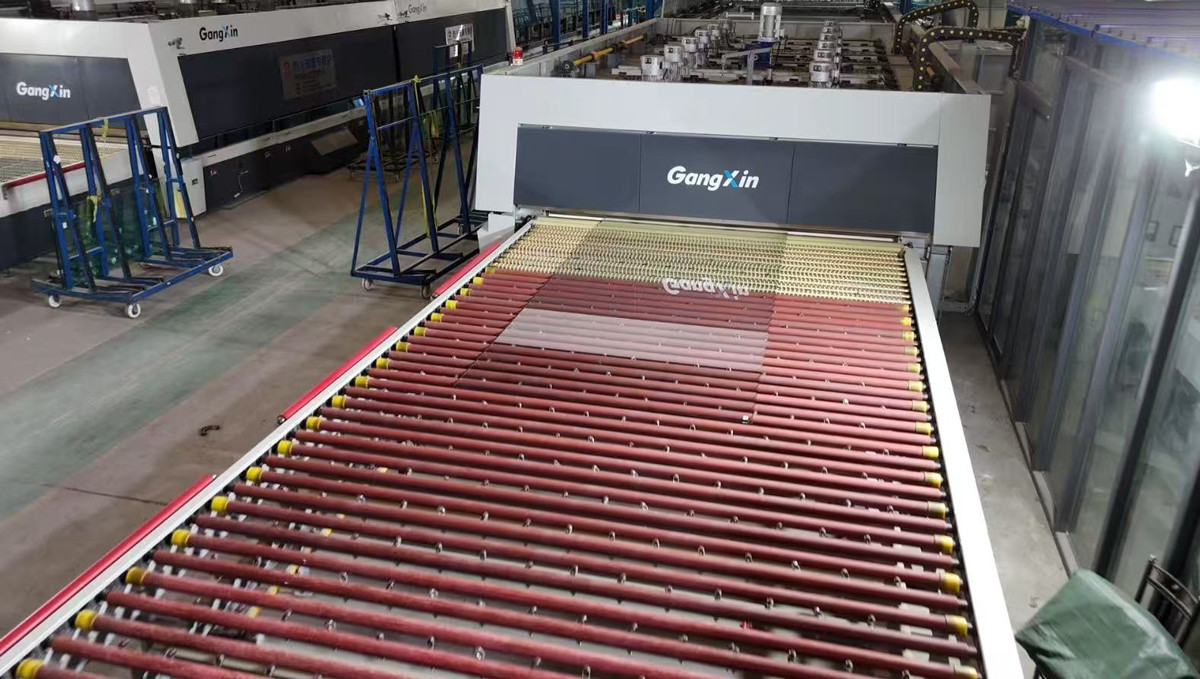
Luoyang Gangxin uses imported high-precision fused silica ceramic rollers with specially polished surfaces. These work in conjunction with an O-belt dual-compound synchronous drive technology to achieve a roller radial runout of ≤ 0.05 mm. The furnaces are also equipped with a dedicated ceramic roller transport mechanism that allows roller removal without personnel entering the furnace, cutting furnace downtime for maintenance by 50% and dramatically reducing both labor costs and the risk of roller damage during handling.
How Does the Control System Guarantee Production Stability?
The Core Role of PLC and Temperature Control Algorithms
The control system is the brain of the tempering furnace, coordinating the entire heating, quenching, and conveying process. High-end systems utilize PLCs from Siemens, Omron, or Mitsubishi, supporting multi-zone PID intelligent temperature control. They can store hundreds of process recipes and automatically adjust the heating curve and quench pressure based on glass thickness and loading density. Low-end relay-based control suffers from large temperature fluctuations and can easily lead to batch scrap.
Proven Performance of Gangxin’s Intelligent Control System
Luoyang Gangxin tempering furnaces integrate an industrial PC with a PLC to achieve automatic reading and writing of process parameters, self-diagnosis of faults, and remote system upgrades. Their proprietary “Discrete Position Control Technology” prevents the glass from oscillating at fixed points during heating. This works together with sealed guide plates between the furnace and the quench section to prevent reverse airflow draft, improving furnace temperature uniformity by 30%. Verified field data shows the system slashes product changeover and debugging time from 2 hours to just 20 minutes, significantly enhancing production continuity.
FAQ: Quick Answers to Common Tempering Furnace Component Issues
Q1: Is high blower vibration always a quality defect?
Not necessarily. First, inspect for bearing wear, dust accumulation on the impeller, or incorrect installation leveling. Gangxin blowers feature oil-cooled bearings and a vibration-damping structure, keeping vibration values to ≤ 2.8 mm/s, well below the industry standard of 5 mm/s.
Q2: How do I troubleshoot frequent heating element breakage?
Start by measuring the resistance (normally 3–10 Ω), then check for localized overheating or mechanical stress. With Gangxin furnaces, the surface temperature of the heating coils is reduced by 50% through convection circulation, more than doubling their expected lifespan.
Q3: How often do ceramic rollers need replacing?
High-quality rollers can last 8–10 years, but they require quarterly cleaning with alcohol and an annual flatness check. Gangxin’s quick-change roller design reduces the typical replacement time from 8 hours down to 2 hours.
Q4: What if the control system crashes?
Immediately activate the manual emergency sheet-unloading device to prevent glass from sticking inside the furnace. Gangxin systems support manual cranking after a power failure and are equipped with safety limit switches and protection pins to prevent secondary damage.
Summary: Remember these three ironclad rules for component selection
✅ Blowers – Prioritize air pressure uniformity and vibration-damping design.
✅ Heating Elements – Insist on NiCr alloy and zoned temperature control.
✅ Rollers – Choose high-precision fused silica ceramic with a quick-change structure.